Will commercial power washing damage my storefront signs or awnings?

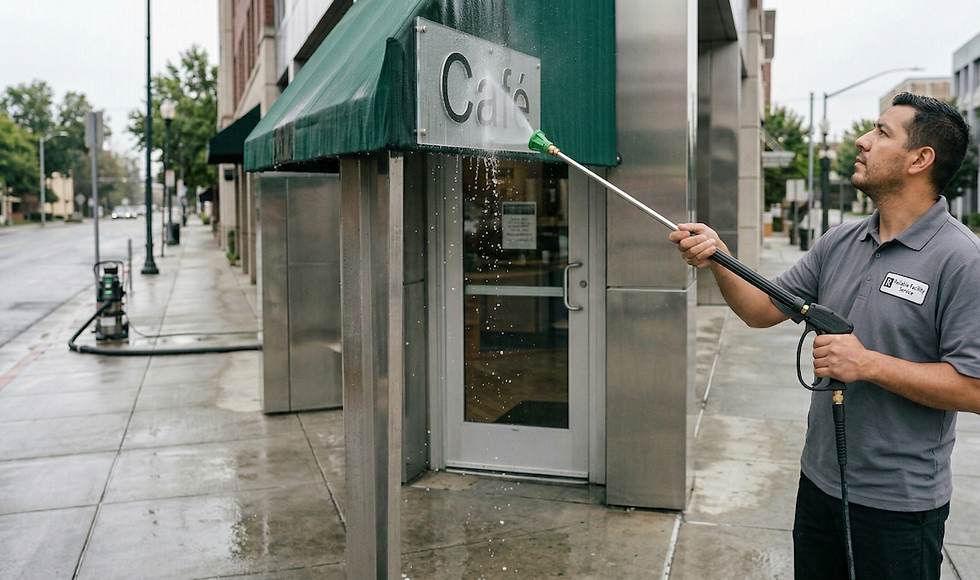
Property managers face a persistent problem in facility maintenance. High pressure water destroys modern signage. Brute force cleaning strips protective coatings and shatters acrylic panels. Effective commercial storefront cleaning San Jose requires absolute precision. High pressure operations do not clean delicate surfaces. High pressure deconstructs them.
A critical error occurs during exterior maintenance known as the shadowing effect. An untrained operator treats a dirty sign without simultaneously washing the surrounding building facade.
The clean area behind the sign creates a permanent UV stain shadow on the building exterior. The expensive signage appears poorly installed. The surrounding paint oxidizes at a different rate. Titanium dioxide in the exterior paint chalks and degrades. You avoid this damage by relying on professionals trained in the science of surface degradation. Visit our Home page to review our complete approach to asset preservation.
The Reality of Exterior Maintenance in Silicon Valley
Silicon Valley properties feature high-tech exterior materials. Traditional power washing causes immediate failure on these modern surfaces. Property owners demand technical solutions.
Hard Water Minerals Meet Tech-Hub Materials
The South Bay municipal water supply contains extreme levels of dissolved calcium and magnesium. Operators measuring the water hardness routinely record levels exceeding 150 parts per million. When technicians apply hot water under high pressure, they bake these hard water minerals permanently into high-tech acrylic displays. The Mohs hardness scale explains the destructive interaction. Calcium carbonate scores a 3 on the Mohs scale. Commercial acrylic signs score roughly a 2. Driving calcium particles into softer acrylic at 3000 PSI causes severe micro-abrasions. The surface turns irreparably cloudy. The friction generates heat. The damage requires complete panel replacement.
To combat this local environmental factor, professional exterior maintenance teams employ reverse osmosis filtration systems mounted directly on their service vehicles. Reverse osmosis strips the destructive calcium molecules from the municipal water supply before the water reaches the pump system. Applying pure water prevents the formation of destructive scaling on your expensive architectural glass and acrylic signs.
The 60 Percent Property Damage Rule
Data dictates operational protocol. According to safety benchmarks and guidelines from the Occupational Safety and Health Administration OSHA, sixty percent of property damage during exterior cleaning occurs because untrained operators ignore strict standoff distance rules and nozzle degree standards. A zero-degree nozzle focuses water into a laser-like stream. This concentrated stream cuts human skin and slices through aluminum storefront framing. Safe operation requires 25-degree or 40-degree nozzles combined with exact standoff distances calculated per surface material. Technicians must calculate the impact force based on the gallons per minute flow rate and the spray angle.
High Pressure Versus Soft Wash Technology
The exterior cleaning industry standard shifted entirely. Water pressure alone fails to clean effectively without causing structural harm. Read about our specific methods on Our Services page.
Moving Away from Brute Force Cleaning
Soft wash equipment sales grew by 3.8 percent year-over-year into 2026. Trained professionals replace indiscriminate pressure with chemical engineering. Soft washing operates precisely between 150 PSI and 300 PSI. This specific pressure range prevents de-lamination on delicate commercial signage. The low pressure matches the force of a standard residential garden hose. Technicians rely on high-volume diaphragm pumps. These pumps deliver 10 gallons per minute to flush away debris without relying on kinetic impact force.
Biodegradable Surfactants and Non-Abrasive Detergents
Dirt, grease, and organic growth require chemical breakdown. Non-abrasive chemicals lift dirt effectively without stripping UV-protected awning coatings. Surfactants break the surface tension of water. The solution penetrates organic matter at a molecular level. Environmental Protection Agency EPA guidelines mandate specific biodegradable formulas to prevent soil toxicity. The correct chemical mixture removes algae and pollution exhaust without requiring abrasive physical force. Technicians apply sodium hypochlorite at a precise 1 percent to 3 percent dilution ratio. This solution requires a ten-minute dwell time. The dwell time allows the chemical reaction to dissolve organic bonds safely.
Protecting Specific San Jose Storefront Assets
Different materials demand distinct operational protocols. A single shopping center contains dozens of different substrates. Review our local municipal coverage on our Service Areas page.
Backlit LED Acrylics and High-Tension Vinyl
High-tension calendared vinyl features strict thermal limits. Hot water applications exceed the adhesive cure temperature of commercial vinyl lettering. The heat melts the adhesive backing. The vinyl peels away from the substrate instantly. Cleaning backlit tech displays safely requires cold-water protocols and specific solvent-free detergents. Operators must measure the concrete moisture parts per million surrounding the sign. High moisture levels indicate poor drainage. Poor drainage allows chemical runoff to pool and wick up into buried electrical housings. Technicians use dielectric grease on all exposed sign fittings prior to water application.
High-End Awnings in Los Gatos and Willow Glen
Boutique neighborhoods feature solution-dyed acrylic fabric awnings. These fabrics feature factory-applied fluorocarbon finishes for water resistance. The 2026 operational standard mandates dry brushing before liquid cleansing. Dry brushing removes abrasive dirt particles. Applying water pressure first drives these silica sand particles deep into the woven fabric fibers. The sand cuts the fibers from the inside over time. The awning frays and collapses. Technicians use soft-bristle hogs hair brushes. Following the wash process, professionals must reapply specific waterproofing sealants to restore the fluorocarbon layer.
Alucobond Panels and Architectural Metals
Modern San Jose storefronts frequently incorporate Alucobond and anodized aluminum panels. These architectural metals possess clear protective coatings vulnerable to acidic degradation. Brute force washing fractures the clear coat. Moisture penetrates the fractured surface and causes rapid oxidation. The metal develops permanent white streaks. Soft washing employs alkaline-based detergents to neutralize environmental acids safely. Technicians rinse the panels using deionized water systems. Deionized water contains zero total dissolved solids. The pure water dries spot-free without requiring physical squeegee application. Physical squeegees drag trapped grit across the metal and scratch the finish.
Compliance and Accountability in 2026
Modern exterior maintenance requires rigorous documentation. Commercial property owners demand total transparency regarding chemical usage and wastewater management.
Digital Logging for Client Trust
Digital logging and photo documentation define professional exterior maintenance. Companies applying digital proof methods achieve a 15 percent improvement in client retention. Technicians record the exact PSI, nozzle degrees, and chemical dilution ratios used on every distinct surface. Property managers gain transparent data verifying adherence to manufacturer warranty specifications. Software tracks the exact pH levels of the runoff.
OSHA-Compliant Rinsing and Runoff
Environmental regulations govern wastewater disposal strictly. The state sets severe limits on storm drain runoff to protect local watersheds. The California State Government mandates containment protocols for commercial cleaning operations. Operators must deploy vacuum booms to reclaim wastewater. Technicians pump the reclaimed water through 5-micron filtration systems. The filtration removes heavy metals and suspended solids. Operators neutralize chemical pH levels before municipal sewer disposal. Failure to capture and treat runoff results in severe municipal fines and immediate site shutdowns.
Conclusion, Call Ruben at Reliable Facility Service to Schedule Your Free Consultation Today

Storefront cleaning requires deep technical expertise. High pressure destroys costly signage and fabric awnings. Soft wash technology guarantees safety and delivers superior restorative results. You need a contractor trained in material science and chemical interaction. Protect your commercial assets from untrained operators. Book a comprehensive site assessment. Navigate to our Contact page to schedule your technical consultation today.
Frequently Asked Questions
Review these common concerns regarding exterior maintenance protocols. Find more detailed operational information on our FAQ page.
Does pressure washing void my awning warranty?
Aggressive water pressure frequently voids manufacturer warranties. Fabric and vinyl manufacturers specify strict chemical cleaning guidelines. Soft wash technology maintains full warranty compliance by using low PSI and approved non-abrasive detergents.
What is the difference between power washing and soft washing for signs?
Power washing uses mechanical force above 2000 PSI to strip surfaces blindly. Soft washing uses chemical application between 150 PSI and 300 PSI. Soft washing relies on chemical reactions to dissolve dirt without physical impact.
How often should storefronts in San Jose be cleaned?
South Bay weather patterns deposit heavy mineral dust and traffic exhaust pollution continuously. Properties on major thoroughfares require quarterly maintenance schedules. Recessed properties or properties in low-traffic zones need bi-annual soft washing to prevent permanent staining.
Will hot water pressure washing melt vinyl lettering?
Hot water exceeds the thermal threshold of commercial vinyl adhesives. The extreme heat causes the vinyl edges to curl and peel permanently. Technicians must use ambient cold water and specific stand-off distances to preserve expensive vinyl graphics.
Will cleaning chemicals damage my sidewalk planters?
Professional operators use approved biodegradable surfactants exclusively. Technicians saturate all surrounding plant life with fresh water prior to any chemical application. This dilution protocol neutralizes stray droplets and guarantees total botanical safety for your landscaping.


